
Dwarf Emerald Rasboras and Celestial Pearl Danios (CPDs): Care Guide
Dwarf emerald rasboras and celestial pearl danios (CPDs) are two of the prettiest nano fish you can keep, and they are close cousins. Both are tiny, both come from the same corner of Myanmar, and both need almost exactly the same care. That is why I have put them in one guide. If you have a planted nano tank, either one will look stunning in it.
What are dwarf emerald rasboras and CPDs?
Despite the common names, neither is a true rasbora. Both are small danios from the hills of Myanmar, and both grow to only about 2 to 2.5cm.
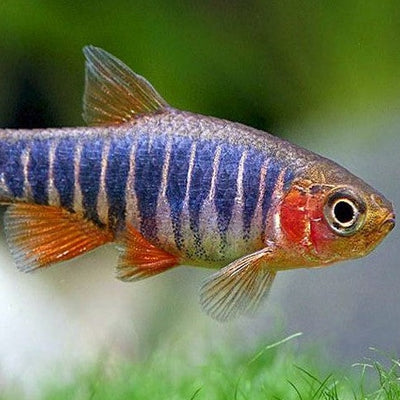
Dwarf emerald rasbora (Danio erythromicron)

Also sold as emerald dwarf rasboras or emerald dwarf danios. They have dark vertical bars on a shimmering green-blue body, with bright orange-red fins. They are a little shy at first, but a settled group in a planted tank is captivating. I breed them here in QLD and raise them on live food. Shop dwarf emerald rasboras
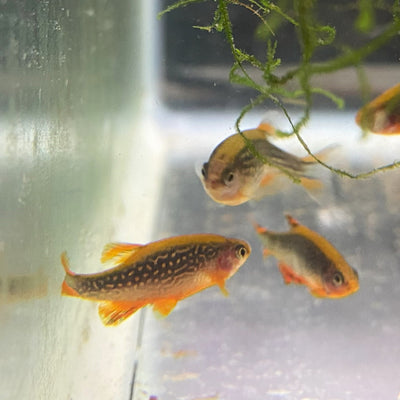
Celestial pearl danio (Danio margaritatus)

Also called CPDs or galaxy rasboras. Up close they look like a tiny night sky, with a deep blue-grey body covered in pearly gold spots and red and black striped fins. Males turn a rich orange-red on the belly when they spar with each other, which they do often but harmlessly. Shop CPDs
How are they different?
- Pattern: Dwarf emerald rasboras have vertical bars. CPDs have spots.
- Behaviour: CPD males spar and show off to each other all day. Dwarf emerald rasboras are a little calmer and tend to stay closer to cover.
- Temperature: Both like slightly cooler water than most tropical fish. Dwarf emerald rasboras are happiest around 20 to 24 degrees Celsius, and CPDs around 20 to 25.
Apart from that, their care is almost identical, and they can share a tank happily.
Tank setup
- Tank size: 30 litres or more for a group. A longer tank gives males more room to display.
- Group size: At least 8. In a bigger group they are bolder and show much better colour. In small numbers they tend to hide.
- Temperature: 20 to 24 degrees Celsius suits both. In most Australian homes a heater is only needed through winter.
- Plants: A heavily planted tank is a must. They feel safe with plenty of cover, and the more secure they feel, the more you will see them. Java moss and floating plants like red root floaters are perfect.
- Filtration: Gentle flow. A sponge filter is ideal and is also safe for fry.
- Substrate: A dark substrate makes their colours really stand out.
Feeding
Both species have tiny mouths, so keep food small. A quality micro pellet or crushed flake makes a good staple. They really colour up on live and frozen food, and daphnia, microworms and baby brine shrimp are all great choices.
New arrivals can be shy at feeding time. If they are not eating well in the first few days, live food is the quickest way to get them going. Feed small amounts once or twice a day.
Breeding
Both species scatter their eggs among moss and fine plants, usually low down in the tank. The adults do not look after the eggs and will eat them if they find them.
The easiest way to breed them is to give them a thick mat of moss or a spawning mop and check it every few days. Move any eggs you find into a separate container with gentle aeration. The eggs hatch in a few days, and the fry are very small. Start them on paramecium or vinegar eels, then move on to microworms and baby brine shrimp as they grow.
In a very heavily planted tank you will sometimes find a few babies growing up on their own, hiding in the moss.
Can they live together?
Yes. They like the same conditions and the same food, and they are both peaceful. If you want to breed and raise fry of each, it is simpler to keep them in separate tanks so you know which babies are which.
Tankmates
These are small, gentle fish, so their tankmates need to be small and gentle too. Good choices include:
- Cherry shrimp (they may eat a few baby shrimp)
- Pygmy corydoras for the bottom of the tank
- Snails
- Other small, peaceful nano fish that like similar temperatures
Avoid anything large enough to eat them, and avoid fast, boisterous fish that will scare them into hiding or eat all the food first.
Why I keep them
Dwarf emerald rasboras and CPDs prove that tiny fish can have just as much colour as big ones. In a planted tank with soft light, a group of either species is one of the prettiest things you can keep, and once they settle you will catch the males displaying every time you look.
If you have any questions about dwarf emerald rasboras or CPDs, email me at elyza@handpickedaquatics.com. Happy to help.
Cheers,
Elyza
Hand Picked Aquatics